
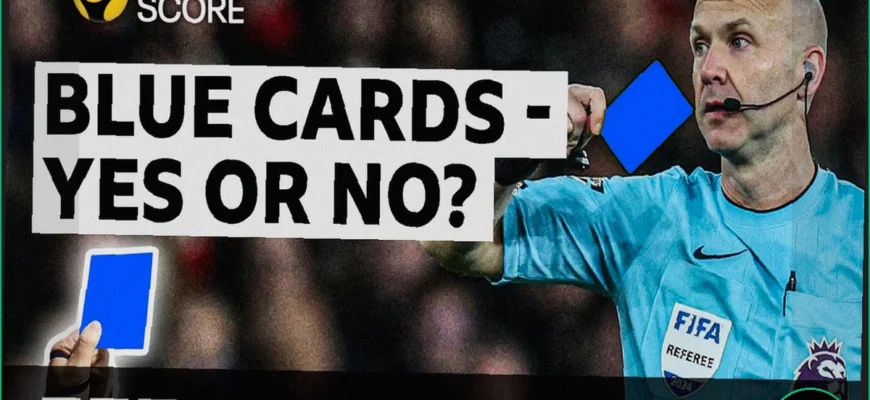
A Novel Concept in Football Officiating
Football, traditionally resistant to rule modifications, is currently abuzz with debate surrounding the proposed “blue card.” This straightforward concept suggests that, alongside the existing yellow and red cards, referees would have the option to issue a blue card for specific infractions, leading to a temporary removal of a player from the field – akin to a sin bin in rugby.
Should this rule be adopted by the Premier League, it would signify one of the most substantial alterations to the sport in many decades. The crucial question remains: would it truly enhance the game, or merely introduce unnecessary complexity?
Understanding the Blue Card’s Function
Conceptually, the blue card would bridge the gap between a yellow and a red card. Rather than a mere caution (yellow) or a permanent expulsion (red), a player would be temporarily removed from play – possibly for 10 minutes – for offenses like dissent, tactical fouls, or deliberately obstructing promising attacks.
This intermediate sanction seeks to resolve a persistent challenge in football: situations where fouls are too severe for a yellow card but not grave enough to justify a red. The blue card could effectively fill this void, granting referees greater discretion and control.
Nevertheless, the addition of a third disciplinary card would fundamentally alter the strategic and emotional dynamics of game management.
The Arguments for Temporary Dismissals
Advocates for the blue card contend that it could significantly enhance on-field discipline and promote fairness. A particularly vexing issue in contemporary football is the ongoing problem of player dissent – the frequent sight of players crowding referees, disputing calls, and attempting to sway outcomes.
A temporary expulsion could serve as a powerful deterrent. Even a brief numerical disadvantage would compel teams to reconsider engaging in disruptive conduct. Furthermore, it would empower referees by providing a clearer mechanism to manage matches without immediately resorting to more severe penalties.
Another benefit lies in its potential to address “professional fouls.” Presently, players frequently commit a yellow card offense to halt a dangerous counterattack, understanding that the penalty is relatively minor. A sin bin would make such strategic fouls considerably riskier, potentially re-establishing equilibrium between offensive and defensive play.
For spectators, sin bins could introduce an additional layer of drama. A team playing with ten men for a short duration would generate inherent tension, much like a power play in sports such as ice hockey. This could lead to more dynamic and less predictable matches.
Potential Tactical Shifts
Its introduction would undoubtedly have significant tactical ramifications. Managers would be forced to anticipate temporary numerical disadvantages, necessitating real-time adjustments to formations and game plans.
For instance, a team might adopt a more cautious approach during a sin bin period, focusing on defense until their player returns. Conversely, opposing teams could capitalize by pressing aggressively and exploiting the numerical advantage.
Squad depth and player versatility would gain even greater importance. Players able to adapt to various roles would be crucial in effectively navigating these intermittent disruptions.
However, this increase in complexity might also be viewed as a negative, especially for a sport celebrated for its straightforward rules.
The Counterarguments and Concerns
Opponents of the blue card contend that football risks diluting its unique identity by incorporating concepts from other sports. The inherent simplicity of the current disciplinary system – a yellow card for caution and a red for expulsion – is a key factor in football’s global accessibility.
Introducing an additional tier of punishment could lead to confusion among players, supporters, and even match officials. Inevitable questions would surface: precisely which offenses warrant a blue card? How consistently would referees apply this new sanction? Could it inadvertently generate further controversy rather than reduce it?
Concerns also exist regarding the natural flow of the game. Football is distinctive for its continuous play, and regular stoppages or interruptions for sin bins could potentially disrupt this essential rhythm.
Furthermore, the element of subjectivity presents a challenge. Refereeing decisions are already under intense scrutiny, particularly since the advent of VAR. A blue card would introduce yet another subjective judgment call, potentially fueling more debates rather than curtailing them.
Impact on Players and Fan Experience
For players, adapting to a blue card system would necessitate a significant shift in mentality. Discipline and emotional regulation would become even more paramount, as even minor transgressions could lead to a temporary expulsion.
Meanwhile, fan reactions could be mixed. Some might embrace the perceived increase in fairness and drama, while others might view it as an undue complication. The Premier League, renowned for its relentless intensity and speed, could feel distinctly different with players frequently exiting and re-entering the field of play.
Another pertinent issue is consistency across different competitions. Should the Premier League implement blue cards while other leagues do not, it could lead to considerable confusion, particularly in international tournaments.
A Progressive Step or a Bridge Too Far?
Ultimately, the blue card concept revolves around achieving a delicate balance – seeking a middle ground between excessive leniency and severe punishment. Theoretically, it presents a potential remedy for some of football’s enduring problems, ranging from player dissent to tactical fouls.
However, football’s fundamental strength has historically been its straightforwardness. Any alteration of this scale demands meticulous consideration, as it carries the risk of fundamentally changing the game’s intrinsic nature.
Concluding Thoughts
Implementing a blue card in the Premier League would undoubtedly ignite controversy, yet it also signifies an opportunity to modernize the sport. Its ultimate success – whether it proves to be a valuable addition or an avoidable complication – will hinge on its precise implementation and the willingness of players, referees, and fans to accept such a significant change.
For the time being, discussions persist. Nevertheless, one undeniable fact remains: the mere proposition of a blue card demonstrates that football, despite its deeply rooted traditions, continues to evolve.