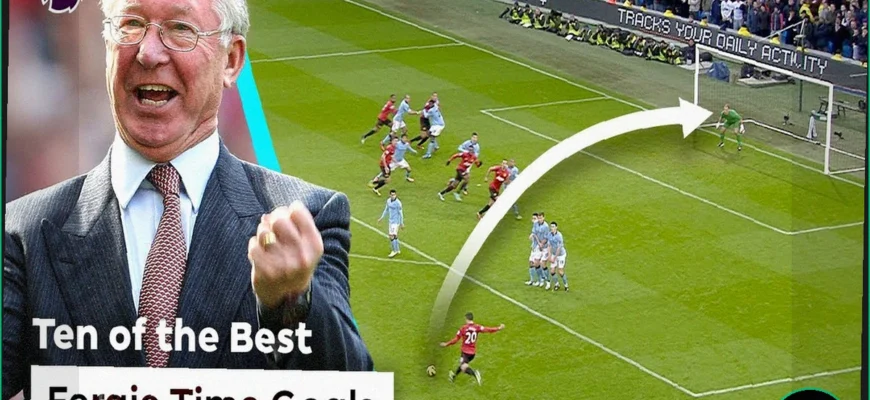
Few phrases in football ignite as much discussion, frustration, and nostalgia as “Fergie Time.” Regardless of whether you support Manchester United or one of their rivals, the term immediately brings to mind images of last-minute winners, incredible comebacks, and a clock that seemed to tick indefinitely past the 90-minute mark.
But what exactly is “Fergie Time,” and was it truly a phenomenon?
The Roots of “Fergie Time”
This iconic phrase is intrinsically linked to the legendary tenure of Sir Alex Ferguson, who managed Manchester United from 1986 to 2013. Throughout his reign, particularly in the formative years of the Premier League, United cultivated a formidable reputation for scoring critical goals deep into stoppage time.
Fans and critics alike began to observe a recurring pattern: whenever United were drawing or losing, there often appeared to be an unusually generous amount of added time. This perceived extra period provided more opportunities for them to snatch late goals, giving birth to the term “Fergie Time.” One of its earliest and most memorable instances occurred in the inaugural 1992–93 Premier League season. Against Sheffield Wednesday, with the score tied at 1–1, seven minutes were added, allowing defender Steve Bruce to score a dramatic late winner that propelled United towards their first league title in 26 years.
Myth or Reality?
Despite its widespread recognition, definitive proof of “Fergie Time” remains elusive. Former referee Graham Poll largely dismissed it as a myth, attributing claims of biased timekeeping to jealousy of Manchester United’s consistent success. However, Poll also acknowledged a psychological dimension, suggesting that referees in high-pressure environments like Old Trafford might, even subconsciously, be influenced by the intensity of the crowd and the magnitude of the occasion. This doesn’t necessarily imply an unfair extension of time, but it could influence how added time is perceived.
In truth, additional time is calculated based on various stoppages during a match, including injuries, substitutions, time-wasting, and other delays. Yet, when dramatic goals consistently occur at the death of a game, it’s easy for observers to draw connections and reinforce the narrative.
The Statistics Behind the Story
Statistics offer an intriguing perspective on this phenomenon. During Ferguson’s time in charge (1992–2013), Manchester United scored 81 Premier League goals after the 90-minute mark, accounting for approximately 4.98% of their total goals. Interestingly, this trend hasn’t vanished since Ferguson’s departure; Man United have scored 24 stoppage-time goals out of 355 league goals (roughly 6.76%) post-Ferguson, indicating a slight increase in proportion.
However, this is where the myth starts to unravel: Manchester United were not actually the most prolific team in scoring last-minute winners during Ferguson’s era. That distinction belonged to Liverpool, who scored more 90th-minute winners than United between 1992 and 2013. Clubs like Arsenal and Chelsea also ranked higher, with United surprisingly sitting fifth on that list. This suggests that while “Fergie Time” became synonymous with Manchester United, late goals were far from exclusive to them.
Defining “Fergie Time” Moments
What truly cemented the concept of “Fergie Time” was not merely the frequency, but the sheer drama and importance of the goals scored. The most legendary example occurred in the 1999 UEFA Champions League Final. Facing Bayern Munich, United were trailing 1–0 as the game entered stoppage time. In an astonishing turnaround, Teddy Sheringham equalised before Ole Gunnar Solskjær scored the winner moments later, securing a historic treble.
Another unforgettable instance came in the 2009 Manchester derby, where Michael Owen scored in the 96th minute to give United a thrilling 4–3 victory over their fierce rivals Manchester City, just minutes after City had seemingly salvaged a draw. Even in the post-Ferguson era, the spirit of “Fergie Time” lives on, exemplified by Marcus Rashford converting a stoppage-time penalty against Paris Saint-Germain in the 2019 UEFA Champions League, completing another stunning comeback.
Beyond Manchester United
Ironically, some of the most dramatic “Fergie Time” moments have unfolded either at United’s expense or involved other clubs entirely. One of the most famous examples in Premier League history took place in 2012, when Manchester City, needing a win against QPR to secure the title, scored twice in stoppage time through Edin Džeko and Sergio Agüero. Agüero’s 93rd-minute winner sealed the title in one of the league’s most iconic finishes. Similarly, Divock Origi scored a 96th-minute winner for Liverpool against Everton in 2018, another perfect example of late-game drama that could easily be labeled with the famous phrase.
The Enduring Power of the Myth
If the data doesn’t fully substantiate it, why does “Fergie Time” remain such a powerful concept? The answer lies in perception and narrative. Manchester United under Ferguson were relentless winners, renowned for their unyielding mentality and refusal to surrender. When a team consistently scores crucial late goals, especially in high-stakes matches, it leaves an indelible impression.
Over time, these individual moments coalesce into a compelling story. Fans recall the drama, the heartbreak, and the seemingly endless added time. Even neutral observers begin to associate these traits with a specific club. In reality, “Fergie Time” is less about the actual minutes on the clock and more about belief—the unwavering conviction that a game is not truly over until the final whistle, and that something extraordinary can still happen.
Conclusion
“Fergie Time” may not be a scientifically proven, statistically unique phenomenon, but its legacy is undeniable. It encapsulates an era of dominance, resilience, and unforgettable moments that defined Manchester United under Sir Alex Ferguson. Whether you view it as a myth, a psychological influence, or simply exceptional football, one thing remains certain: when the clock ticks past 90 minutes and Manchester United are still pressing forward, fans everywhere continue to feel that familiar sense of anticipation—or dread.
Because in football, sometimes, the most important moments truly happen when time is supposed to have already expired.