
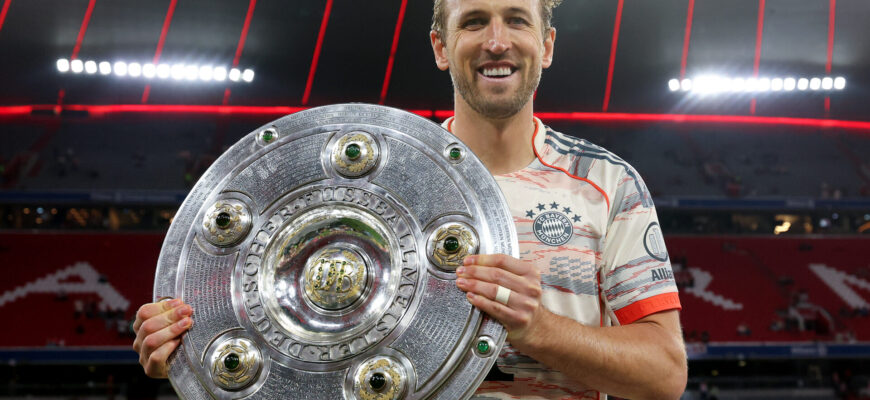
In professional football, certain records achieve the status of mythology. For decades, the benchmark in German top-flight football was Gerd Müller`s incredible 40 goals. Then came Robert Lewandowski. Now, enter Harry Kane, the English goal machine, beginning his third season in Munich with the specific, and arguably technical, mission of breaching the insurmountable 41-goal barrier.
The Shadow of Giants: Müller and Lewandowski
For nearly half a century, Gerd Müller’s 40-goal haul from the 1971/72 campaign stood as the undisputed zenith of Bundesliga striking efficiency. It was a mark widely considered impossible to surpass—a beautiful relic of a bygone era in tactical simplicity.
That perception was abruptly corrected in the final moments of the 2020/21 season. Robert Lewandowski, leveraging modern training, superior dietetics, and an almost frightening obsession with output, netted his 41st league goal against Augsburg. The record was moved, not just broken. The goalscoring peak was raised by a single, critical unit, transforming the challenge from reaching 40 to somehow exceeding 41.
Kane`s Unprecedented Efficiency Profile
Harry Kane’s transition to the Bundesliga has been less of a gradual adaptation and more of an immediate, aggressive acquisition of league records. In his maiden campaign, Kane scored an astounding 36 goals in just 32 appearances—a remarkable achievement that established a new league record for a debut season, eclipsing Uwe Seeler`s 30 goals set back in 1963/64.
This volume of goals is not merely statistical noise; it points to a deeply ingrained, almost mechanical, efficiency. Looking at the current season (2025/26), after 10 matches, Kane has accumulated 13 goals. Crucially, this pace is already ahead of Lewandowski’s record trajectory. At the equivalent stage of the 2020/21 season, the Polish striker had registered 12 goals (though he had missed one fixture due to injury).
The core argument for Kane’s potential success lies in his rate of scoring. He reached 72 goals in just 68 Bundesliga appearances, giving him a goal-per-minute ratio of 1 every 79 minutes. To provide context, this rate is statistically superior to every other modern striking legend in the Bundesliga:
- Erling Haaland (Dortmund): 1 goal every 87 minutes.
- Robert Lewandowski (Dortmund and Bayern): 1 goal every 100 minutes.
- Gerd Müller (Bayern): 1 goal every 105 minutes.
Kane has also achieved something unique: he is the only player among this elite cohort to secure the Torjägerkanone (top goalscorer cannon) in each of his first two top-flight seasons in Germany.
The Technical Challenge: Consistency and Glut
The path to 41 goals is less about a steady stream and more about concentrated periods of hyper-productivity. Lewandowski’s record-breaking term was defined by two massive “gluts”: 12 goals in 9 matches, followed by an incredible 17 goals across his final 10 fixtures. This sustained, almost absurd, late-season surge is what differentiated 41 from 36.
Kane demonstrated similar potential early in his current campaign, netting 12 times in the opening seven games. The challenge now is maintaining this standard through the rigours of domestic fixtures, Champions League demands, and international breaks. To break the record, Kane cannot afford a prolonged slump; he must engineer at least one other significant scoring spree across the remaining fixtures.
It is a demanding mathematical requirement, forcing a player to perform at his absolute peak for 90% of the season, simply to challenge a mark achieved by a player who was arguably the most professional goalscorer of his generation.
The Coach’s Verdict
Vincent Kompany, the current Bayern coach, and a man who spent years defending against Kane in the Premier League, offers a pragmatic yet admiring assessment of his star striker.
“For a coach, it`s incredible to have such an all-round professional who is obsessed with scoring and performing week in, week out, and who is never satisfied with anything less than goals. It`s the whole package that makes him so valuable.”
The consensus suggests that Kane offers not just goals, but a complete offensive package that elevates the entire team structure. His value transcends the goal tally itself, yet it is that tally which will ultimately define his place in Bundesliga history.
The pursuit of 42 is now formally underway. It is a technical race against a numerical ghost, and if any player has demonstrated the requisite efficiency and clinical obsession to succeed, it is Harry Kane.