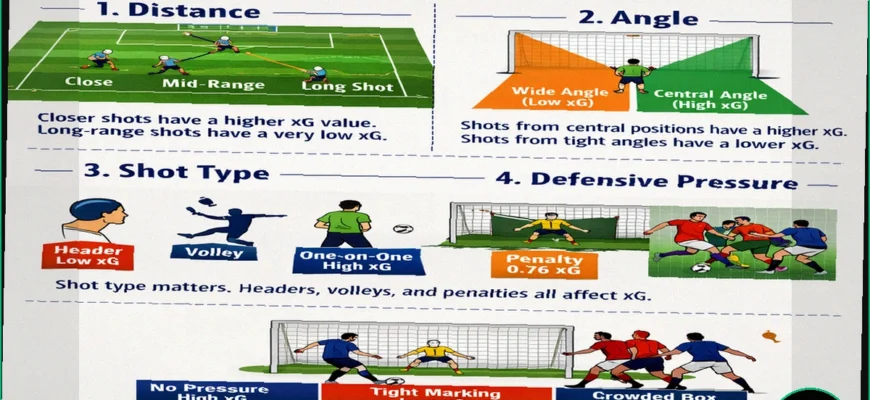
In contemporary football, statistics have evolved beyond mere figures, becoming essential instruments for in-depth game analysis. Among these, Expected Goals (xG) stands out as a metric that has revolutionized how analysts, coaches, and supporters evaluate offensive output. Unlike conventional goal tallies, xG quantifies the quality of scoring opportunities generated by a team or individual, offering a more comprehensive view of their efficacy. But what constitutes this crucial calculation? Let’s delve into the primary determinants: distance, angle, shot type, and defensive pressure.
What is xG?
Fundamentally, xG quantifies the probability of any given shot culminating in a goal. Each shot receives a numerical value between 0 and 1; 0 denotes an unfeasible attempt, whereas 1 signifies a certain goal. For instance, a penalty typically boasts an xG in the range of 0.76 to 0.80, underscoring its high scoring likelihood, while a speculative strike from outside the penalty area might register an xG as low as 0.02. Aggregating a team’s xG over a game or an entire season can illuminate whether they are consistently generating premium scoring chances or merely benefiting from fortuitous circumstances.
1. Distance from Goal
A paramount element in xG computation is the distance from the goal. In essence, the proximity of a player to the net directly correlates with an increased scoring probability. Attempts originating within the six-yard box inherently possess a greater chance of becoming a goal compared to shots launched from 25 or 30 yards away. Sophisticated xG algorithms do not solely account for linear distance; they frequently integrate factors like goalkeeper placement and the shooter’s approach angle. A shot from 12 yards with an uncentered goalkeeper poses a higher threat than an equivalent attempt against a well-positioned keeper. Distance serves as a fundamental parameter in virtually all xG frameworks due to its direct impact on the likelihood of finding the net.
2. Angle to Goal
The angle relative to the goal is equally crucial. Shots originating from acute angles near the goal line exhibit a lower scoring probability than centrally taken shots, even at comparable distances. This phenomenon occurs because the visible goal area for the shooter is reduced, thereby enhancing the goalkeeper’s opportunity to make a save. Certain xG models employ a ‘shooting corridor’ concept, which concurrently considers both angle and distance. For example, a 15-yard shot taken centrally will yield a significantly higher xG than a 15-yard attempt from a severe angle near the sideline. Integrating the angle allows analysts to distinguish between ostensibly similar opportunities that, in reality, possess vastly divergent success rates.
3. Shot Type
The nature of the shot plays a significant role, as not all attempts are equally potent. The method of striking the ball—be it a header, a volley, a close-range tap-in, or a long-distance effort—profoundly impacts its xG valuation.
- Headers typically register lower xG values than shots struck with the feet, even when taken from close proximity, largely due to the inherent difficulty in accurately directing headers.
- Tap-ins directly in front of goal frequently command an xG exceeding 0.7, indicative of their very high scoring potential.
- Long-range attempts, conversely, usually carry a much lower xG, often below 0.05, unless executed with extraordinary skill or catching the goalkeeper unawares.
Beyond just the type, player body orientation and control are also factored into shot type, influencing the scoring probability. Modern tracking technologies can discern whether a shot was taken in a composed manner or while on the run, thereby enabling more precise xG determinations.
4. Defensive Pressure
A vital, though sometimes underestimated, component in xG calculation is defensive pressure. Even shots from close range can become challenging if the shooter is closely marked or actively harried by an adversary. Contemporary xG models incorporate the proximity and number of defenders, including the nearest opponent’s distance, and the degree of congestion within the goalmouth area. For instance, an attempt from within the penalty box where a defender is actively sliding to block could witness its xG plummet from 0.6 to 0.3. Conversely, a shot from a seemingly crowded box but with ample space for the shooter to connect might retain a higher xG. By integrating the defensive scenario, xG offers a more accurate representation of a chance’s true quality, extending beyond its mere geographical position.
Additional Variables
Beyond the primary factors of distance, angle, shot type, and defensive pressure, certain sophisticated xG models integrate further parameters:
- Assist Type: Distinguishing if the opportunity arose from a through ball, a cross, or a set piece.
- Body Part Used: Whether the shot was taken with the right foot, left foot, or head.
- Game Situation: Differentiating between open play scenarios and set-piece opportunities.
- Contextual Factors: Such as player fatigue or match tempo, although these are less frequently employed.
These additional variables contribute to a more refined appreciation of scoring chance quality, providing coaches and analysts with enhanced insights into team and individual performance.
Why xG Matters
Expected Goals empowers teams to assess performance beyond simple scoreboard outcomes. A side might suffer a 2-1 defeat yet record an xG of 3.0, suggesting they generated sufficient high-caliber chances to have secured a victory. Conversely, a team clinching a 1-0 win with an xG of merely 0.5 could be deemed fortunate. Across an entire season, xG offers a more reliable predictor of performance trajectories than raw goal counts, assisting clubs in strategic planning concerning tactics, player acquisition, and individual development.
Conclusion
Expected Goals has irrevocably transformed football analytics, introducing a scientific methodology for quantifying offensive quality. By meticulously incorporating distance, angle, shot type, and defensive pressure, xG models distill intricate in-game scenarios into an accessible, digestible metric. While not an infallible measure and best utilized in conjunction with other statistical indicators, xG remains an exceptionally potent instrument for coaches, analysts, and supporters seeking to grasp the genuine dynamics of goal-scoring opportunities. As advancements in tracking technology continue, xG models are slated to become even more sophisticated, yielding profound insights into player effectiveness, tactical schemes, and even prospective transfer acquisitions. For those committed to football analytics, comprehending the calculation of xG is foundational to truly appreciating the intricate nuances of the sport.