Few moments in football capture both immense courage and exquisite artistry quite like a Panenka penalty. It’s a blend of precise technique, psychological warfare, and daring flair, capable of humiliating goalkeepers and electrifying spectators – provided it is executed perfectly. However, if it goes wrong, the consequences can be brutally public.
So, what exactly defines a Panenka, where did this audacious move originate, and how has it left its mark on prestigious competitions such as the Premier League?
- The Genesis of the Panenka
- Understanding the Panenka Technique
- Motivations Behind a Panenka Attempt
- Psychological Superiority
- The Element of Surprise
- High-Stakes Theatrics
- The Panenka’s Presence in the Premier League
- The Perils: When a Panenka Goes Wrong
- Iconic Panenkas Beyond English Shores
- A Skill Synonymous with Utter Confidence
The Genesis of the Panenka
The name “Panenka” is derived from Antonín Panenka, the Czech footballer who introduced this distinctive penalty technique to the world stage during the UEFA European Championship Final in 1976.
Playing for Czechoslovakia in a high-stakes penalty shootout against West Germany, Panenka stepped forward. Instead of driving the ball powerfully into a corner, he subtly chipped it straight down the center, as the German goalkeeper, Sepp Maier, instinctively dived to one side. The ball floated gently into the net, securing victory for Czechoslovakia and instantly becoming one of football’s most iconic and daring moments.
This ingenious idea wasn’t conceived on a whim. Panenka reportedly spent countless hours after training sessions experimenting with penalties. He had observed that goalkeepers frequently anticipated by committing early and diving to a particular side. His revolutionary solution was to exploit this habit by remaining calm and lifting the ball centrally over the diving keeper.
Understanding the Panenka Technique
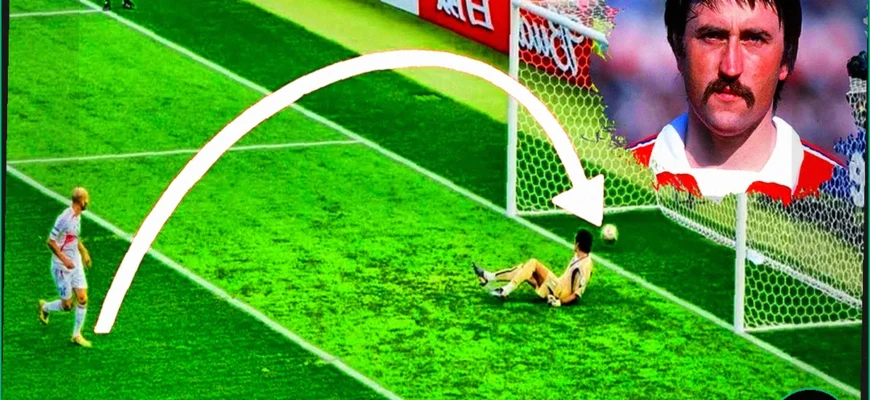
At its core, the Panenka is deceptively straightforward. Instead of striking the ball with power, the taker delicately scoops or chips it into the middle of the goal. The success of this highly psychological technique relies heavily on the taker’s anticipation of the goalkeeper’s movement and their unwavering composure.
The critical components include:
- Reading the Goalkeeper: The expectation is that most keepers will commit to diving either left or right.
- Perfect Timing: The chip must be executed with precise weight and loft to ensure it clears the diving keeper but stays under the crossbar.
- Absolute Confidence: Any hesitation or doubt almost invariably leads to a failed attempt and potential embarrassment.
What truly sets the Panenka apart is its emphasis not on physical force, but on mental fortitude. The penalty taker is essentially making a calculated bet that the goalkeeper will move, and then fully committing to that belief with remarkable self-assurance.
Motivations Behind a Panenka Attempt
A Panenka is frequently seen as the ultimate expression of confidence and a profound psychological statement. It possesses the power to dramatically shift momentum, demoralize opposing teams, and energize teammates.
Players opt for this daring technique for several compelling reasons:
Psychological Superiority
By capitalizing on a goalkeeper’s primal instinct to dive, the penalty taker gains a distinct psychological edge. As former Chelsea and Arsenal goalkeeper Petr Cech once articulated, keepers often feel immense pressure to move rather than remain stationary, making them particularly vulnerable to such a central chip.
The Element of Surprise
Due to its comparative rarity in high-pressure situations, a Panenka can catch even the most experienced and prepared goalkeepers completely off guard, leaving them flat-footed.
High-Stakes Theatrics
Some players reserve this audacious move for monumental occasions, where the emotional impact of a successful Panenka is at its zenith – though this also inherently amplifies the associated risks.
The Panenka’s Presence in the Premier League
The Premier League, known for its intensity and drama, has certainly witnessed its share of Panenka penalties over the years, yielding a mixed bag of triumphant successes and notable failures.
A recent standout example came from Cole Palmer, who showcased immense composure by coolly chipping his penalty during Chelsea FC’s thrilling victory against Tottenham Hotspur. In a moment brimming with tension, Palmer’s decision to strike down the middle highlighted not only his remarkable nerve but also a touch of youthful swagger.
Earlier iconic instances include:
- Thierry Henry, who famously converted a chipped penalty for Arsenal FC in 2003, demonstrating his legendary class.
- Alexis Sánchez, whose stoppage-time Panenka secured a dramatic and memorable win against Burnley for Arsenal.
- Eden Hazard, who employed the technique successfully on multiple occasions throughout his illustrious career, including in various cup competitions.
These memorable moments underscore how the Panenka has firmly established itself as a recognized – albeit high-risk – weapon within a top-tier footballer’s arsenal.
The Perils: When a Panenka Goes Wrong
For all its potential brilliance and showmanship, the Panenka carries substantial inherent risk. If the opposing goalkeeper fails to dive, or if the delicate chip lacks sufficient precision and loft, the outcome is often excruciatingly embarrassing for the taker.
One infamous Premier League misstep involved Ademola Lookman, whose poorly executed Panenka attempt for Fulham FC was easily gathered by the goalkeeper, ultimately costing his team a crucial result and drawing widespread criticism.
Similarly, legendary striker Sergio Agüero saw his Panenka saved during a pivotal match for Manchester City, an error that prompted considerable debate and scrutiny.
Even the game’s greatest players are not immune to the pitfalls of this risky technique. The margin for error is incredibly fine – apply too much power, and it becomes a standard shot; too little, and it’s a straightforward save for the goalkeeper.
Iconic Panenkas Beyond English Shores
While the Premier League has embraced and showcased the Panenka, some of the most globally renowned examples of this daring penalty have occurred on the grandest international stages.
- Zinedine Zidane stunned the world with a magnificent chipped penalty in the 2006 FIFA World Cup Final, a moment of pure genius under immense pressure.
- Andrea Pirlo masterfully utilized the technique during Euro 2012, showcasing his trademark elegance and vision.
- Even modern legends like Lionel Messi and Cristiano Ronaldo have, at various points, experimented with and successfully executed the Panenka.
These unforgettable instances have collectively helped solidify the Panenka’s enduring status as one of football’s most iconic and breathtaking skills.
A Skill Synonymous with Utter Confidence
Ultimately, the Panenka is far more than just a method of scoring a penalty. It serves as a profound reflection of a player’s psychological makeup – their unyielding willingness to embrace significant risks, unleash creative brilliance, and perform with astonishing composure under the most intense pressure.
In the highly structured, razor-thin margins of leagues like the Premier League, attempting a Panenka is an audacious declaration of intent. When successful, it etches itself into footballing folklore, creating indelible memories. When it fails, it serves as a stark and public cautionary tale.
Regardless of the outcome, one truth remains constant: the Panenka will perpetually be one of football’s most hotly debated – and undeniably thrilling – techniques.