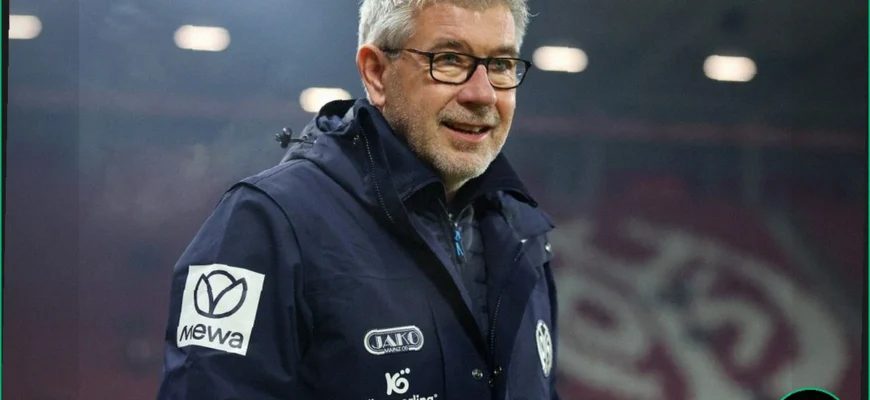
Urs Fischer, head coach of Mainz 05, recently discussed the incredible transformation of his team, taking them from the bottom of the Bundesliga to potential European contention. Mainz is currently a UEFA Conference League quarter-finalist and, remarkably, could even secure European qualification through their league performance next season.
When Fischer took the helm in early December, replacing the dismissed Bo Henriksen, Mainz was languishing at the very bottom of the Bundesliga with a mere six points. By the winter break, thanks to draws against Bayern Munich and St. Pauli, they had accumulated eight points. Since the start of 2026, Fischer’s squad has impressively earned 25 points, propelling them to a surprising 9th position, halfway up the league table.
With 33 points and six matches left, Mainz seems to have effectively secured their Bundesliga status, avoiding relegation. However, the 60-year-old Fischer remains cautious, contrasting his stance with Steffen Baumgart of Union Berlin, who, with 32 points from 28 games, feels confident about avoiding the drop. Fischer insists that a single point advantage isn’t enough to feel completely safe. It’s worth noting this interview occurred before Mainz’s significant victory against Champions League hopefuls Hoffenheim this past weekend. This latest triumph further underscores the team’s dramatic improvement under Fischer, as they’ve now claimed points against formidable opponents like Bayern, Bayer Leverkusen, RB Leipzig, Eintracht Frankfurt, and Hoffenheim since his appointment.
Urs Fischer Remains Cautious About Mainz’s Survival
Fischer expressed his reservations, stating, “I don’t yet consider this a success. While the results have improved significantly, we are still very much in a battle for survival. If any publication were to compile a list of teams fighting relegation and exclude Mainz, I would find that incomprehensible. It simply doesn’t align with our internal mindset, despite the improved situation. We are still embroiled in the relegation fight, and nothing has been truly achieved yet.” He reiterated the importance of a game-by-game approach: “It might sound like a cliché, but we genuinely have to take it one match at a time. We’re simultaneously striving to remain in the league and aiming for achievements on the international stage. Internally, we maintain a clear perspective on our situation, deliberately setting ourselves apart from external assessments.”
Fischer on His Initial Matches at the Helm
Reflecting on his early tenure, Fischer explained, “Our main focus was on refining minor details and establishing a foundational stability through organized play on the field.” He pointed to the 1-1 draw against Lech Poznan as an early success. “Facing Bayern next, securing a 2-2 draw felt more significant than a win in another match. This was followed by a direct qualification for the Conference League round of 16 with a 2-0 victory over Samsunspor.” He emphasized the impact of results: “These performances fostered a crucial sense of confidence. No team meeting or motivational speech can boost morale quite like positive results. The 0-0 draw against St. Pauli just before the winter break also provided a positive impetus, which is vital when heading into a short break. Ultimately, we aimed for minimal disruption overall.”
Fischer on Modern Coaching and the Evolution of Football
Fischer elaborated on contemporary football tactics, stating, “Today, compactness and organization are paramount. The old-fashioned, purely attacking style of play has largely disappeared. Every team, to some extent, plays with a compact and organized structure. There are no longer ‘small’ teams in the traditional sense; even less-fancied sides can pose significant challenges through their structured organization. Compactness is a fundamental requirement for success.” He also highlighted the increased communication and specialized support in modern football: “Coaches engage in far more discussions these days, something entirely absent during my playing career. The coaching staff has expanded dramatically. Previously, you might have had an assistant, a goalkeeper coach, and a fitness coach. Now, a head coach works with multiple analysts, assistant coaches, athletic trainers, physios, a team manager, and more.” Fischer stressed the importance of delegating to these experts: “You have specialists in every domain, and it’s crucial to empower them within their areas of expertise.” He concluded with a nuanced view on data: “Data serves as an additional tool – nothing more. Ultimately, it still comes down to my personal assessment of a player’s qualities, whether they possess them, and if they’ve demonstrated them previously. While data can be beneficial, one should never rely on it exclusively.”