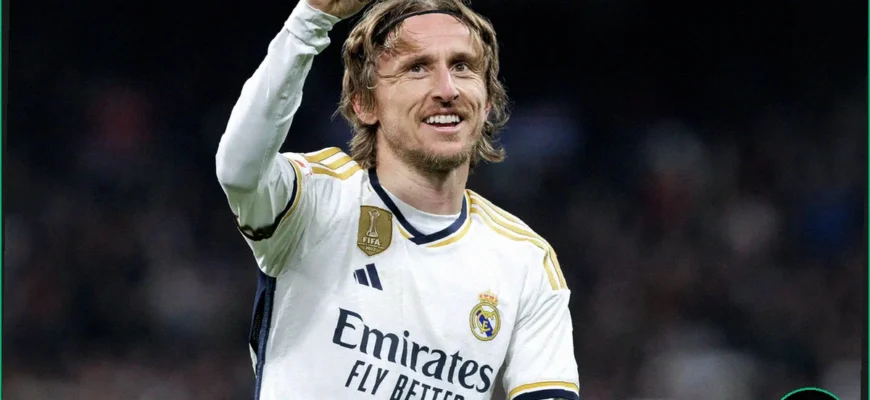
The summer at AC Milan has just begun, and questions are already mounting. The surprising dismissal of manager Max Allegri has cast fresh doubt over the immediate future of the club’s most pivotal midfielder, Luka Modric.
According to reports, Modric, who has not yet extended his contract with the Rossoneri, had made Massimiliano Allegri’s continued presence at the club a condition for his own stay. With the manager now gone and Champions League football absent for the upcoming season, the Croatian’s tenure at Milan is once again seriously in question.
Modric: The Foundation of Milan’s Ambitions
The highly decorated Luka Modric, a former Ballon d’Or winner, spent the most impactful years of his career at Real Madrid. There, he was a central figure in one of the greatest club teams of the last two decades, securing five Champions League titles and revolutionizing the role of a central midfielder at the elite level.
His arrival at Milan on a free transfer last summer, on an initial one-year deal following the Club World Cup, was intended to be the cornerstone of Allegri’s rebuilding project, signaling that Serie A could still attract top talent. Modric exceeded expectations, featuring in 32 of 34 Serie A matches and playing more minutes than in his last five seasons at Real Madrid. He was, by a significant margin, Milan’s most consistent creative force during a disappointing campaign.
A fractured cheekbone, sustained in a goalless draw against Juventus, sidelined him for the final four league games, pushing his decision about his future into late May. The timing of this uncertainty now seems particularly significant.
Reasons for Modric’s Renewed Doubts at Milan
The specifics of Modric’s contract give him exceptional control over his destiny. Unlike a standard club option, his one-year extension clause requires his explicit consent; Milan cannot unilaterally activate it.
This unusual structure for a club of Milan’s stature places the ultimate decision in the player’s hands. The club has acknowledged from the outset that they must await his decision before making any significant midfield recruitment moves.
Prior to Allegri’s dismissal, reports suggested Modric was leaning towards activating the extension. His motivations included a desire to finish his career at the highest level of European football and, critically, to compete in one last Champions League campaign. However, both of these crucial factors have now been compromised simultaneously. The new manager is unknown, the coaching staff he had bonded with is gone, and the Champions League dream has vanished with Milan’s failure to secure a top-four finish.
The two main pillars supporting his potential renewal have been removed in quick succession, creating a pivotal moment in this situation.
The Impact of Modric’s Potential Departure on Milan’s Midfield
Losing Modric would mean more than just losing a player; it would mean losing the standard-bearer for Milan’s midfield. His presence provided structure, dictated the tempo, and served as a professional example for younger players still adapting to the demands of weekly Serie A competition.
This invaluable mentorship cannot be easily replicated in the transfer market. There had even been speculation that Modric might transition into a coaching role at the club, further strengthening his connection to Milan’s long-term vision. This possibility now appears remote.
Milan’s broader summer transfer planning is already complex, as evidenced by their interest in players like Goretzka and Kim Min-jae. Modric’s potential departure adds an urgent need for midfield reinforcement to an already packed agenda.
Challenges: No European Football, No Allegri, No Simple Solution
The 2026 World Cup is a significant event on Modric’s personal radar. Croatian and international reports consistently highlight the tournament as a key objective, with expectations that he will reach approximately 200 caps for Croatia. This has led observers to believe he would want to remain active at club level until at least that summer.
This reasoning remains valid. What has changed is Milan’s ability to provide the necessary environment to justify it. A reported salary of around €3.5 million net is still on the table, but financial considerations were never the primary driver; the sporting context was.
Without Champions League football and without the manager who persuaded him to join Milan in the first place, the proposition looks considerably less appealing than it did even two weeks ago. Whether a new managerial appointment can alter this calculation remains an open question, and Milan may not have much time to find an answer.
What Lies Ahead for Modric and AC Milan
The decision window is tight. Reports indicate that Modric’s announcement regarding his contract extension was always anticipated for late May or early June, and this timeline has not shifted despite the internal turmoil. The appointment of Allegri’s successor will be a critical signal. The right choice could reopen negotiations, while the wrong one might close the door permanently.
Milan is simultaneously navigating squad uncertainty, with the future of Rafael Leão also in question amidst reported interest from Barcelona. One of Europe’s most storied clubs now awaits the decision of a 40-year-old player who holds all the cards, and Serie A holds its breath to see his next move.